


INBRIJA. RAPID, RELIABLE, ANYTIME, ANYWHERE1-3

Anytime, anywhere3, a single inhaled dose of INBRIJA offers on‑demand relief for OFF episodes by restoring motor function in adult Parkinson’s patients of any age or disease stage, with consistent delivery of levodopa.4
INBRIJA can help your patients return to ON. Patients experiencing OFF episodes can quickly regain control of their lives1, enabling them to stay socially connected and active.
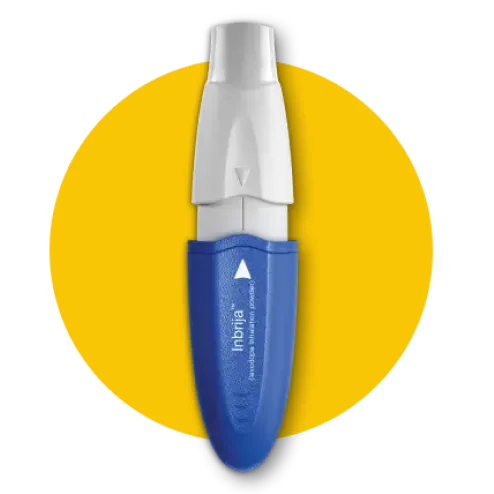
Consistent absorption
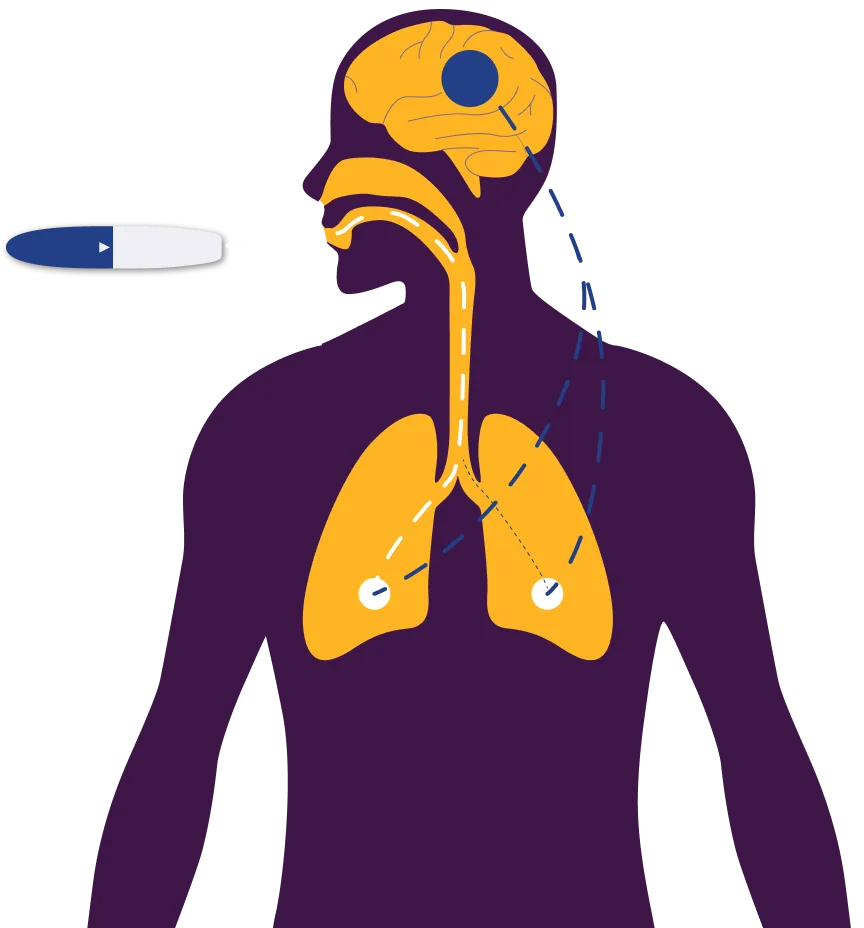
When it’s time for on-demand treatment, INBRIJA delivers
Administered via the pulmonary route, INBRIJA enables consistent absorption3

Avoids variability caused by GI tract absorption3

Allows for use when needed5
Patients experiencing OFF episodes can quickly regain control of their lives, enabling them to stay socially connected and active
- Inhaled levodopa bypasses the gut for rapid, consistent bioavailability5
- Can be taken anytime, anywhere3
- Effective in adult patients of all ages and disease stages4
- No adjustment of baseline medication needed5
INBRIJA delivers consistent plasma concentrations starting within 10 min3
Results from a randomised, open-label, 2-way crossover study evaluating the pharmacokinetics of a single inhaled dose of INBRIJA 84 mg, administered with oral carbidopa 25 mg, and a single ingested dose of carbidopa (CD) / levodopa (LD) 25/100 mg in fed state in patients with Parkinson’s who were regularly taking oral CD/LD.3,*,†
INBRIJA 84 mg† (n=20)3

Adapted from Safirstein BE, Ellenbogen A, Zhao P, Henney HR 3rd, Kegler-Ebo DM, Oh C 2020
Oral CD/LD 25/100 mg (n=17)3
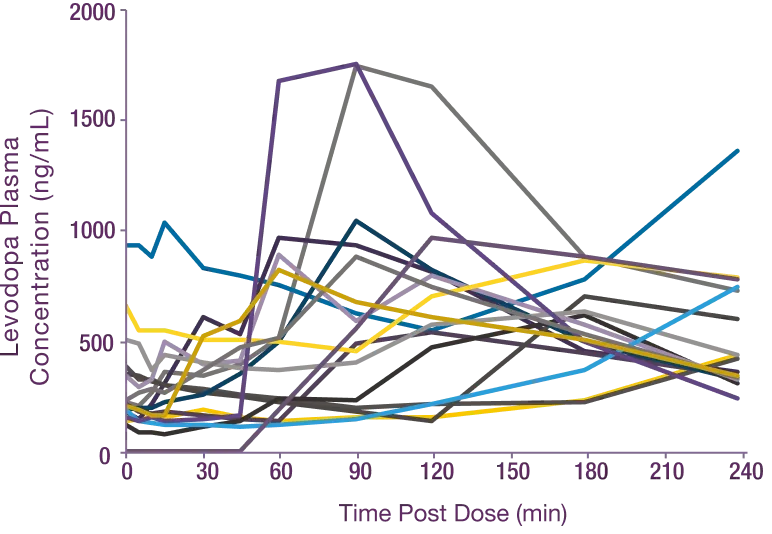
Adapted from Safirstein BE, Ellenbogen A, Zhao P, Henney HR 3rd, Kegler-Ebo DM, Oh C 2020
- *4 to 5 hours after morning CD/LD, patients ate a meal and then received study drug.
- †INBRIJA 84 mg coadministered with 25 mg oral carbidopa for true pharmacokinetic comparison to levodopa.
INBRIJA — rapid, reliable relief observed in as few as 10 minutes1
Post-dose, INBRIJA delivered:

Rapid onset of action observed in as little as 10 minutes1

Significant improvement in motor function (p=0.009) (primary endpoint)1

Sustained effect1
UPDRS Part III score change from 0‑60 minutes post-dose at week 121
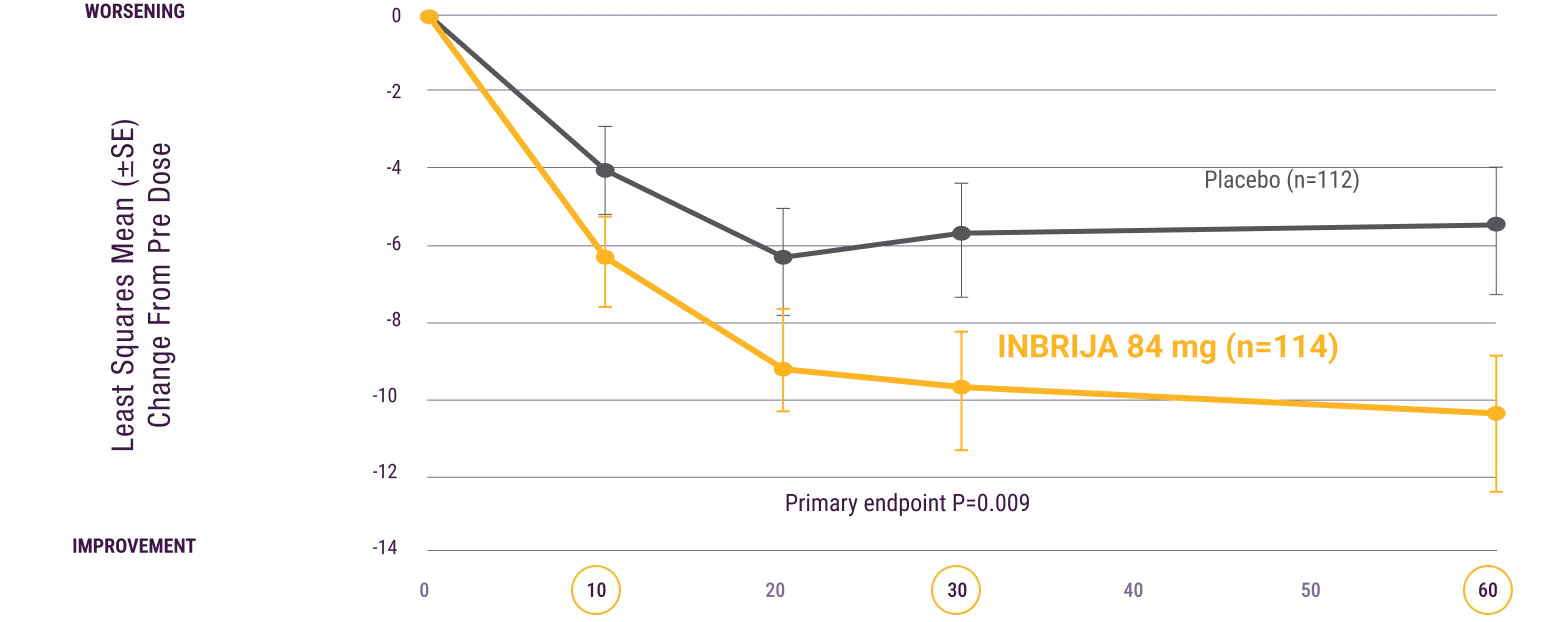
Adapted from LeWitt PA, Hauser RA, Pahwa R, et al. 2019
SE, standard error; UPDRS, Unified Parkinson’s Disease Rating Scale.
INBRIJA pivotal study
INBRIJA was studied in a 12-week randomised, double-blind, placebo-controlled study evaluating the efficacy and safety of INBRIJA for the treatment of OFF episodes in patients with Parkinson’s.1
Study design (N=226)1
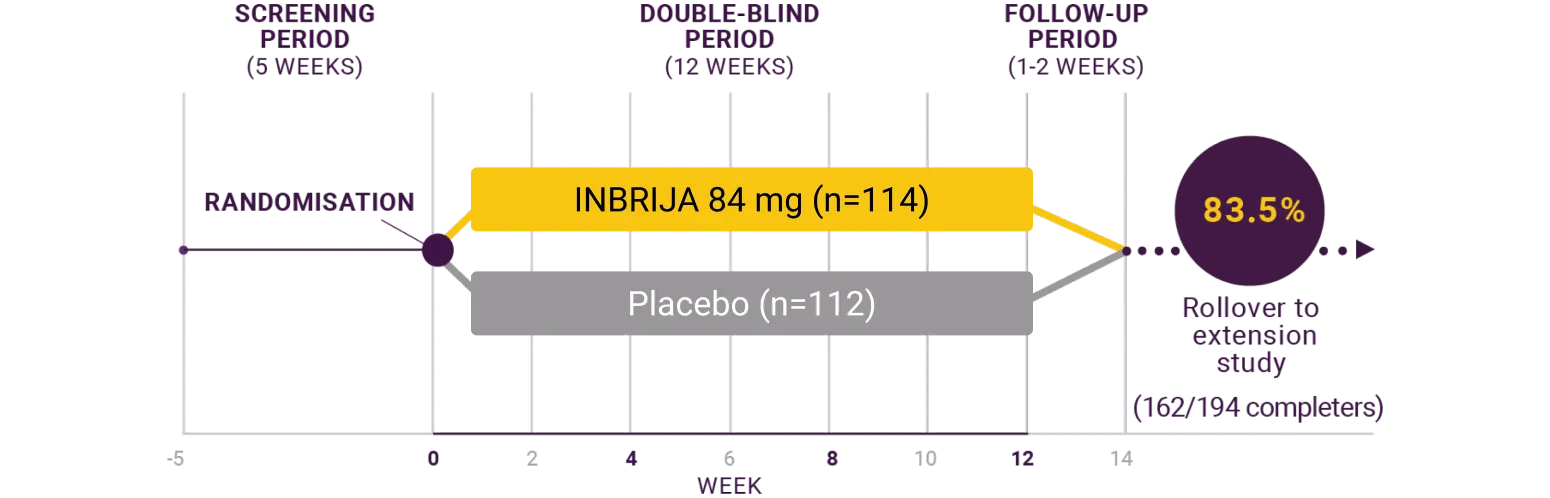
Adapted from LeWitt PA, Hauser RA, Pahwa R, et al. 2019
The primary endpoint of the INBRIJA pivotal study was UPDRS Part III* motor score at 30 minutes: change from predose OFF to 30 minutes post dose with INBRIJA 84 mg vs placebo.1
Patients at baseline had:
- CD/LD regimen including 819 mg/day of levodopa
- Hoehn and Yahr stage <2.5 (63% of patients)
- 5.4 hours of OFF time per day
- Mean UPDRS Part III motor scores in ON stage at screening: 14.9 for INBRIJA 84 mg and 16.1 for placebo
Key exclusion criteria:
- Patients with asthma, COPD, or other chronic respiratory disease4
- Use of apomorphine1
*UPDRS Part Ill is a composite measure of 14 items designed to assess the severity of primary motor symptoms (eg, tremor, rigidity, bradykinesia, postural instability) in patients with Parkinson’s. Disability level is evaluated using 27 assessments with a total score of 108 points.6
References: 1. LeWitt PA, Hauser RA, Pahwa R, et al; SPAN-PD Study Investigators. Safety and efficacy of CVT-301 (levodopa inhalation powder) on motor function during off periods in patients with Parkinson’s disease: a randomised, double-blind, placebo-controlled phase 3 trial. Lancet Neurol. 2019;18:145-154. 2. Luinstra M, Rutgers W, van Laar T, et al. Pharmacokinetics and tolerability of inhaled levodopa from a new dry-powder inhaler in patients with Parkinson’s disease. Ther Adv Chronic Dis. 2019;10: 2040622319857617. 3. Safirstein BE, Ellenbogen A, Zhao P, Henney HR 3rd, Kegler-Ebo DM, Oh C. Pharmacokinetics of inhaled levodopa administered with oral carbidopa in the fed state in patients with Parkinson’s disease. Clin Ther. 2020;42:1034-1046. 4. Inbrija Summary of Product Characteristics. Available at https://www.ema.europa.eu/en/documents/product-information/inbrija-epar-product-information_en.pdf. Last Accessed May 2025. 5. Isaacson SH, Pagan FL, Lew MF, Pahwa R. Should “on-demand” treatments for Parkinson’s disease OFF episodes be used earlier? Clin Park Relat Disord. 2022;7:100161. 6. Fahn S, Marsden CD, Caine DB, Goldstein M, eds. Recent Developments in Parkinson’s Disease; vol 2. Macmillan Health Care Information; 1987:153-163, 293-304.